One of the central questions I've been trying to answer during my time at The Clinton School of Public Service is this: How do I use my specific set of gifts and talents to benefit the most people?
This has been a tricky question to answer because, like most folks, I'm not fully aware of all of my gifts and talents. Most of us don't realize our potential. To me that's one of the strongest arguments for programs that emphasize field service. Nearly twenty years ago, the full year intern teaching experience provided by Trinity University helped me enter the classroom more prepared and now my three field projects at the Clinton School are helping me understand public service in more depth than I would have from pure classwork.
In some ways it's been a two-year process of elimination. From my time in Israel, I've realized that I don't have the gift of linguistics. Being in a country in which I couldn't read or speak either of the two primary languages showed me clearly that learning a new language doesn't come easily to me and; therefore, limits my ability to make a difference. I'm certain I did some useful work in Israel, and I'm very glad I went, but I think my impact could have been greater if I had a better ear for languages.
From my current experience in Canada, I can safely rule out 'professional researcher' from the list of future service careers. Apparently I'm more of an extrovert than I thought because sitting in a cubicle for hours at a time has taught me that I really need human interaction.
About a month ago, I escaped from my cubicle for an hour and wandered around the nearby neighborhood. I found a local branch of the Toronto public library. On the bulletin board inside I saw an advertisement for "English Conversation Circles". This program offered weekly meetings for people interested in improving their English. "I can speak English," I thought, "and there are no cubicles involved!" So I volunteered to help.
The Roots of Empathy folks gave me permission to take two hours every Friday to be a part of this program. It's been one of the highlights of my week for the past three weeks. I've met and talked with people from Russia, Afghanistan, Pakistan, India, Somalia, Malaysia, and China. I love it! While "Professional researcher" and "Linguist" may have been eliminated in this process, I think "Conversation facilitator" has found a spot on my list of gifts and talents. Now the question is: How do I use that skill to have the biggest positive impact?
I'm open to suggestions. And job offers. :-)
Sunday, November 7, 2010

Wednesday, October 27, 2010
Research Karma
Dear Former Students,
Do you remember research assignments? Do you remember writing annotated bibliographies on community service issues? Do you remember summarizing current events articles? Do you remember trying to find international organizations dealing with the service issue your group had chosen?
I do.
And I remember you not liking them very much.
Good news for those of you who thought ill of me for giving you those assignments:
This cubicle is my world during the workday. And in that world there's only one thing to do. Research. That, my friends, is karma.
Fortunately, I believe strongly in the mission of the organization I'm doing the research for. Roots of Empathy has the potential to make a major positive impact on education for kids, teachers, and parents everywhere.
Hopefully when your kids are in school they'll be benefiting from this research.
love,
Monteith

Do you remember research assignments? Do you remember writing annotated bibliographies on community service issues? Do you remember summarizing current events articles? Do you remember trying to find international organizations dealing with the service issue your group had chosen?
I do.
And I remember you not liking them very much.
Good news for those of you who thought ill of me for giving you those assignments:
This cubicle is my world during the workday. And in that world there's only one thing to do. Research. That, my friends, is karma.
Fortunately, I believe strongly in the mission of the organization I'm doing the research for. Roots of Empathy has the potential to make a major positive impact on education for kids, teachers, and parents everywhere.
Hopefully when your kids are in school they'll be benefiting from this research.
love,
Monteith

Tuesday, September 14, 2010
Waiting for SuperSubstance

In a nutshell the documentary is about the current state of U.S. public education, the reasons for its recent decline, and some hopeful solutions for its future. As a former teacher, I was very excited to see this movie because I thought it would bring to light many important issues and be a catalyst for conversation and change. Two of the people featured in the movie are Geoffrey Canada, whom I'd read about in the phenomenal book "Whatever It Takes," and Michele Rhee, whom I'd seen speak at the Clinton School last year.
The film does do a good job of raising some important issues, but it left me more disappointed than anything else. I've thought about it for a couple of days now, and I think the directors just bit off more than they could chew with this one. It probably would have been a better movie if they'd focused on either Geoffrey Canada and the Harlem Children's Zone, or Michele Rhee and the DC public schools, or the KIPP charter schools. Instead the movie looks at all three, and throws in a few more charter schools, and tells the story of several children going through the lottery system to get out of the public schools and into a charter school, and gives a history of public schools, and throws in the obligatory barb at George W making a grammar mistake. It's too much.
In order to pack in that many elements corners had to be cut. Unfortunately, those corners included an in-depth look at any of the problems, and the voices of teachers. I agree with some of the points in the film - the tenure system is horribly flawed and does more harm than good; there is a significant degree of fiscal waste in the public education system; and great teachers have an enormous impact on their students to name a few. However, I was disappointed by the portrayal of teachers' unions as complete villains. And I was most disappointed by the absence of the voices of teachers.
The film makes the following logical links: Great teachers = Good education. Good education = Highly educated citizenry. Highly educated citizenry = Necessary for national security. Therefore, Great teachers are vital to our national security. Another fine point that I agree with, but then the movie NEVER DEFINES GREAT TEACHING. The two most significant clips that I can recall with teachers include a teacher teaching math by rapping and the U.S. Teacher of the Year explaining the cumbersome and ineffective process used to fire bad teachers. Granted great teaching is really hard to define, but if you're making a film that is going to influence the national conversation on teaching, don't you think you explore those muddy waters a bit?
Despite my disappointment, I would encourage you to see the film. Then I would encourage you to read the book "Whatever It Takes" because it does a more thorough job of delving into some of the issues more deeply. I would also encourage you to read up about the adventures of Michele Rhee. Then maybe you'll have a more complete picture and can have the informed conversation this movie is hoping you will.
Friday, September 10, 2010
Brought to you by the letter...
...E
The first chapter in my time in Toronto stands out because of the following E's.
Empathy. That was the easy one. I'm sure you saw it coming, but it needed to be said anyway. I had high hopes and expectations (bonus "e") for the Roots of Empathy (ROE) organization and they have been exceeded (and another!). ROE's commitment to their mission is deeper than I honestly thought possible in the modern business world. Every decision they make has to meet the standard of promoting their goal of developing empathy and changing the world one child at a time.
Next - English. After spending the summer being illiterate because I didn't know Hebrew or Arabic, my brain is both relieved and excited to read and hear English again. Even better is that the English in Toronto is flavored with accents from all over the world. And occasionally I get a little break from English because so many other languages are spoken in Toronto too. I LOVE the diversity of this city!
Finally - Eye contact. This one surprised me. I didn't experience much eye contact in Israel. I'm not sure why. Even while I was there I didn't fully appreciate the distance created by the lack of eye contact. Many people in Toronto will make eye contact while walking down the street or riding in the subway. I enjoy the connection it creates between other people even if it's brief.
The first chapter in my time in Toronto stands out because of the following E's.
Empathy. That was the easy one. I'm sure you saw it coming, but it needed to be said anyway. I had high hopes and expectations (bonus "e") for the Roots of Empathy (ROE) organization and they have been exceeded (and another!). ROE's commitment to their mission is deeper than I honestly thought possible in the modern business world. Every decision they make has to meet the standard of promoting their goal of developing empathy and changing the world one child at a time.
Next - English. After spending the summer being illiterate because I didn't know Hebrew or Arabic, my brain is both relieved and excited to read and hear English again. Even better is that the English in Toronto is flavored with accents from all over the world. And occasionally I get a little break from English because so many other languages are spoken in Toronto too. I LOVE the diversity of this city!
Finally - Eye contact. This one surprised me. I didn't experience much eye contact in Israel. I'm not sure why. Even while I was there I didn't fully appreciate the distance created by the lack of eye contact. Many people in Toronto will make eye contact while walking down the street or riding in the subway. I enjoy the connection it creates between other people even if it's brief.
Sunday, September 5, 2010
Roots of Empathy
The next chapter in this service journey takes place in Toronto. For my third and final project (aka Capstone project) at the Clinton School of Public Service I'll be working with the organization Roots of Empathy. My project work begins in a couple of days. I'm really looking forward to seeing the organization in action. Everything I've read leads me to believe that I'll be exploring one of the root (no pun intended) issues that I've been trying to find during my time at the Clinton School.
I've been doing some looking back during my transition into this next step forward. Some of the things I've seen in my rearview mirror...
...Teaching. I miss it. In particular I miss the students and faculty at the International School of the Americas (ISA). The beginning of the school year is one of my favorite times of year. Last year at this time I was distracted by beginning the Clinton School. This year, I just feel a big hole that used to be filled by the energy of the classroom.
...Books. I tried to take a lesson from my trip to Israel, in which I brought 17 books for a 10-week trip. It was a heavy lesson to learn. For my trip to Toronto, I only brought 9 books. As I unpacked my belongings, I gave myself a big pat on the back for learning that lesson. Then I promptly went out and bought 6 books in a 3-day period. Sigh. Old habits die hard. At least they were all used.
...Teamwork. Assuming I get a job again, I hope it's one in which I actively and regularly collaborate with others. I miss my teammates from ISA. And I miss my teammates Anna and Latonya from my first project at the Clinton School. I really enjoy working with others.
Peace, friends.
I've been doing some looking back during my transition into this next step forward. Some of the things I've seen in my rearview mirror...
...Teaching. I miss it. In particular I miss the students and faculty at the International School of the Americas (ISA). The beginning of the school year is one of my favorite times of year. Last year at this time I was distracted by beginning the Clinton School. This year, I just feel a big hole that used to be filled by the energy of the classroom.
...Books. I tried to take a lesson from my trip to Israel, in which I brought 17 books for a 10-week trip. It was a heavy lesson to learn. For my trip to Toronto, I only brought 9 books. As I unpacked my belongings, I gave myself a big pat on the back for learning that lesson. Then I promptly went out and bought 6 books in a 3-day period. Sigh. Old habits die hard. At least they were all used.
...Teamwork. Assuming I get a job again, I hope it's one in which I actively and regularly collaborate with others. I miss my teammates from ISA. And I miss my teammates Anna and Latonya from my first project at the Clinton School. I really enjoy working with others.
Peace, friends.
Saturday, August 7, 2010
Better Flat than Never
I'm no longer in Israel, but I'll be thinking about the trip for quite a while. I'll use that as a flimsy excuse for introducing someone I should have introduced at the beginning of this experience: Flat Stanley.
Flat Stanley is the main character in a popular series of Children's Books. He's also the star of an international literacy and community building project. Read more about the project begun by teacher Dale Hubert in 1995 and currently promoted by Arkansas' First Lady Ginger Beebe.
I was a pretty big fan of literacy prior to my trip to Israel both personally because I love to read and professionally because of my years in the classroom. I'm an even bigger fan of literacy now. The English alphabet, all 26 beautiful letters, is one of the things I missed the most while I was in Israel. I don't read or speak Hebrew or Arabic, so wandering through the cities was at times very frustrating.
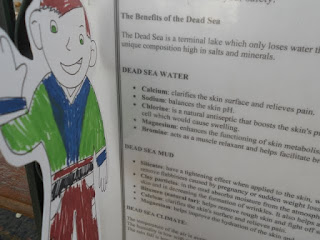 That frustration has motivated me to participate more actively in promoting literacy.
My contributions to Flat Stanley's travels...
Here we see Flat Stanley standing on the shore of the Dead Sea and reading about the unique attributes of that body of water.

And then adding to his journal about the experience.
 |
| Flat Stanley reading about Israel while in Beersheva, Israel. |
Flat Stanley is the main character in a popular series of Children's Books. He's also the star of an international literacy and community building project. Read more about the project begun by teacher Dale Hubert in 1995 and currently promoted by Arkansas' First Lady Ginger Beebe.
I was a pretty big fan of literacy prior to my trip to Israel both personally because I love to read and professionally because of my years in the classroom. I'm an even bigger fan of literacy now. The English alphabet, all 26 beautiful letters, is one of the things I missed the most while I was in Israel. I don't read or speak Hebrew or Arabic, so wandering through the cities was at times very frustrating.
 That frustration has motivated me to participate more actively in promoting literacy.
My contributions to Flat Stanley's travels...
Here we see Flat Stanley standing on the shore of the Dead Sea and reading about the unique attributes of that body of water.

And then adding to his journal about the experience.
 |
| Flat Stanley partaking in a little metacognition. |
Monday, August 2, 2010
Cheesy Vacation Pics
 |
| A dip in the Dead Sea. (pun intended) |
"When I see the sea once more will the sea have seen or not seen me?" ~Pablo Neruda

Waking up at 4:30 a.m. to hike up the Snake Path and watch the sunrise is more fun than Mr. Flavius makes it sound.

Indescribable.
Subscribe to:
Posts (Atom)